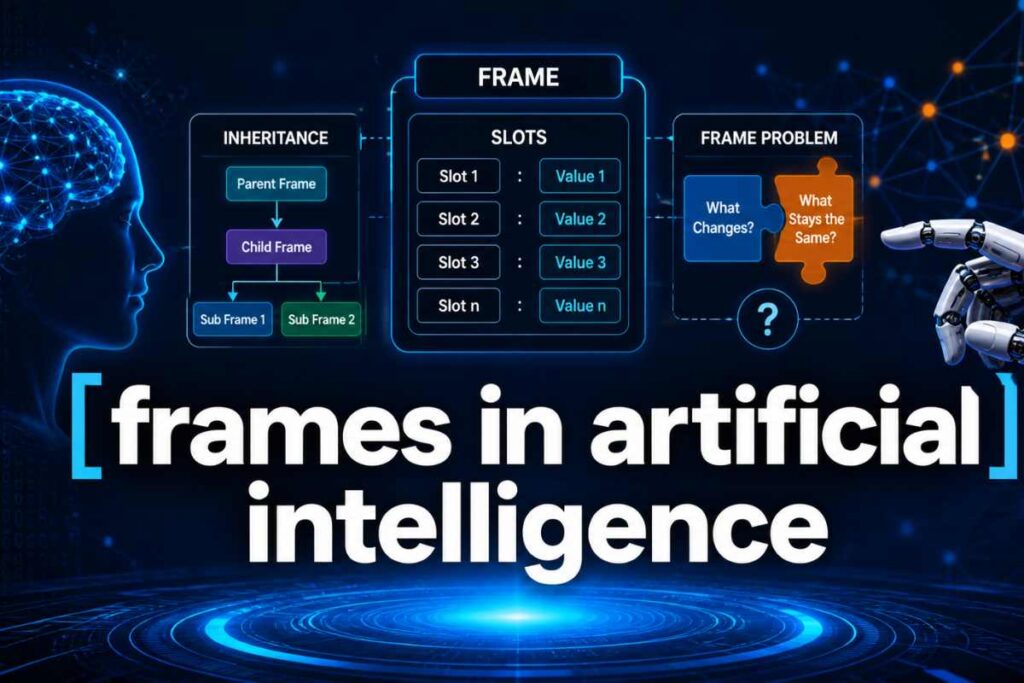
Frames in Artificial Intelligence play a vital role in how machines represent and process real-world knowledge. They help AI systems understand relationships, make inferences, and adapt to different contexts.
Frames are a cornerstone of knowledge representation, providing structured templates for storing information about objects, situations, and experiences. From expert systems and natural language processing to robotics and cognitive modeling, frames enable machines to reason like humans.
Humans organize knowledge logically and hierarchically. This article explores what frames are, how they work, their real-world applications, and how the Frames in Artificial Intelligence continue to influence modern research.
What Are Frames in Artificial Intelligence
A Frames in Artificial Intelligence is a data structure used to represent a stereotypical situation, object, or concept. Introduced by Marvin Minsky in 1974, frames act as blueprints that organize knowledge into slots and fillers. Each slot represents an attribute or property, and each filler represents.
The value or instance of that attribute. For example, a Car frame may include slots such as Make, Model, Color, and Year. The fillers for these slots could be the Toyota Corolla Red and the 2023 model. Together, they form a structured representation that an AI system can interpret, compare, and reason about.
This approach helps bridge the gap between symbolic reasoning and real-world data. Frames are not just storage systems; they’re semantic maps that allow AI systems to connect information logically, understand relationships, and make informed decisions.
Concept and Structure of Frames
The concept of frames stems from cognitive psychology, where humans use mental structures to interpret familiar situations. Frames in Artificial Intelligence mimic this idea by providing a structured way to capture knowledge about the world. Each frame represents a specific concept or scenario and consists of several key components that define its behavior and content.
Frame
The main entity representing a concept or object. For instance, a Restaurant frame might contain details about menu items, staff, and services.
Slots
These are the attributes or properties associated with a frame. In a Restaurant, frame slots might include Menu Cuisine, Location, and Opening Hours.
Fillers
Fillers provide the actual values for slots. For example, the Cuisine slot could have a filler like Italian, while Location could be New York.
Facets and Defaults
Facets define constraints or types for slots, such as data type or valid range. Default values serve as fallback information when specific data is missing.
Procedures
Some frames include procedures and small pieces of logic that describe how to use or modify information in the Frames in Artificial Intelligence.
For instance, a Customer Account frame might include a procedure to calculate discounts or loyalty points. By combining these components, a frame-based system in artificial intelligence can reason efficiently, reuse knowledge, and maintain logical consistency across a large database.
Example of Frames in Artificial Intelligence
Let’s illustrate this with a practical example: Imagine an AI-based library management system. A Book frame might include the following attributes:
- Title: To Kill a Mockingbird
- Author Harper Lee
- Publication Year 1960
- Genre Fiction
- Availability Available
This structure allows the AI system to answer queries like:
- List all books by Harper Lee.
- Which fiction books are available
- Show books published before 1970
Each question can be answered by referencing frames that store and organize book-related data.
Similarly, a LibraryItem frame might serve as a parent to both Book and Magazine frames, allowing them to inherit shared properties such as Title and Publication Year.
Frames in Artificial Intelligence
Frame inheritance is one of the most powerful aspects of the frame-based system in AI. It works similarly to inheritance in object-oriented programming, where child frames inherit attributes from parent frames. A Vehicle frame might include slots like Make, Model Engine.
Type and Year. A Car Frames in Artificial Intelligence child inherits these attributes, but can add specific ones like Number of Doors or Fuel Type. A Truck frame might extend it with Cargo Capacity or Axle Count. This hierarchy ensures that AI systems can reuse knowledge without redundant definitions.
It also simplifies reasoning. If an AI knows that a car is a type of Vehicle, it automatically understands that cars share the general properties of vehicles. This inheritance model makes frame-based knowledge systems both scalable and intuitive.
Frames and Scripts in Artificial Intelligence
While frames represent static knowledge objects, structure attribute scripts represent dynamic knowledge sequences of events or actions that unfold over time. For example, a Restaurant Script might describe the procedural knowledge of how a dining experience progresses.
Together, frames and scripts in artificial intelligence help systems not only understand data but also predict what is likely to happen next, a key ability in reasoning and natural language understanding.
Applications of Frames in Artificial Intelligence
Frames have been applied across many branches of AI. Here are a few important realm world uses:
Expert Systems
Frames form the backbone of many expert systems. In medical AI, for instance, frames can represent diseases, symptoms, and treatments. A system like MYCIN, an early AI diagnostic tool, could use frames to identify potential illnesses based on patient data.
Natural Language Processing NLP
Frames help NLP systems understand context and meaning. When processing a sentence like Book a table at an Italian restaurant the system refers to a booking frame and a restaurant frame to identify the entity’s intent and relationships involved.
Robotics
In robotics, frames represent physical objects and their spatial relationships. This helps robots recognize and interact with their surroundings, for example, knowing that a cup is an object that can contain liquid and is usually found on a table.
Cognitive Modeling
Frames in Artificial Intelligence simulate how humans organize and retrieve knowledge. They are used in cognitive modeling to develop systems that mimic human decision-making and memory structures.
Semantic Networks and Knowledge Graphs
Modern AI uses frame concepts in semantic networks and knowledge graphs such as those powering Google Search. These systems structure information into nodes and relationships, essentially modern implementations of frame theory.
Advantages of Using Frames
Frames provide several benefits that make them indispensable for AI knowledge systems:
- Organized Knowledge Representation Frames help structure information in a way that aligns with how humans think and categorize concepts.
- Inheritance and Reuse The hierarchical nature of frames supports scalability and consistency across large systems.
- Flexibility Frames can be easily extended or modified as new data becomes available.
- Efficient Reasoning. By storing knowledge contextually, AI systems can draw inferences faster and more accurately.
User feedback from developers working with frame-based systems often highlights that frames make complex knowledge domains easier to model and maintain. Many note that frame-based approaches reduce redundancy and improve the interpretability of Frames in Artificial Intelligence.
Challenges and the Frame Problem in Artificial Intelligence
Despite their strengths, frames face several challenges, the most significant being the Frames in Artificial Intelligence. The frame problem refers to the difficulty of determining which parts of a system’s knowledge should change and which should remain constant when an action occurs. In simple terms, when something in the world changes, such as an AI robot moving a cup from.
The table to the shelf must update its internal representation; the cup’s location changes, but its color, shape, and ownership remain the same. The Frames in Artificial Intelligence problem lies in efficiently identifying and updating only the relevant knowledge without re-evaluating the entire knowledge base.
Researchers have proposed several solutions to mitigate this issue, including using logic-based
reasoning frameworks like situation calculus. Employing default reasoning to assume stability unless stated otherwise. Leveraging modern knowledge graphs and relational models for contextual updates. In modern AI, this problem continues to influence research in reasoning, common-sense AI, and dynamic knowledge systems.
Frames vs. Ontologies: Understanding the Difference
Both frames and ontologies are used for knowledge representation, but they serve slightly different purposes.
Frames are flexible, context-driven structures designed for representing specific situations or domains. Ontologies, in contrast, are formal, standardized Frames in Artificial Intelligence used to describe entire knowledge domains using classes, properties, and relations.
While frames might represent a Car as a structured instance with attributes like make and model, ontology defines what a Car means universally, how it relates to other entities, and which logical rules apply.
In short:
- Frames = practical contextual representation
- Ontologies = formal domain-wide standardization
Many AI systems today combine both approaches using ontologies for global consistency and frames for contextual reasoning.
User Experiences and Thoughts on Frame-Based Systems
Professionals working in AI and knowledge engineering often view frames as one of the most intuitive and human-like methods of knowledge representation. In feedback from developers and researchers:
- Some note that frames bridge symbolic and neural AI, allowing hybrid systems that combine structured reasoning with modern deep learning.
- Others emphasize that frames improve explainability, making AI decisions more transparent.
- A few caution that maintaining large frame hierarchies can become complex over time, especially when knowledge evolves dynamically.
Overall, the consensus is clear: frame-based systems remain a powerful, interpretable, and flexible method for representing knowledge, especially in expert-driven AI applications.
Conclusion
Frames in Artificial Intelligence represent one of the earliest yet most enduring approaches to knowledge representation. By structuring information into slo, ts values, hierarchical frames, AI systems to think in context, infer logically, and interact with the real world more intelligently.
Although modern AI often relies on deep learning, the principles behind frame-based reasoning are far from obsolete. They continue to influence semantic web technologies, knowledge graphs, and explainable AI models.
As the field evolves, understanding frames and addressing the Frames in Artificial Intelligence remains essential for building transparent, interpretable, and context-aware systems that truly understand the world.
FAQs
What are frames in artificial intelligence?
Frames are data structures that represent stereotypical situations or objects in AI, organizing knowledge into slots (attributes) and fillers (values) for reasoning and inference.
What is the frame problem in artificial intelligence?
The frame problem refers to the challenge of determining which facts should change and which should remain unchanged when an action occurs in an AI system.
How are frames used in AI applications?
Frames are used in expert systems, NLP, robotics, and knowledge representation to model structured information and reasoning processes.
What is the relationship between frames and scripts in artificial intelligence?
Frames represent static knowledge while scripts represent dynamic sequences of events. Together, they allow AI systems to understand both structure and process.
How do frames differ from ontologies in AI?
Frames are flexible and context-specific, whereas ontologies are formal and standardized representations used for domain-wide consistency.
Are frames still used in modern AI?
Yes. While deep learning dominates current AI, frames remain crucial in explainable AI, reasoning systems, and hybrid knowledge models that combine symbolic and neural methods.