The free throw line distance is one of the most important measurements on a basketball court, influencing both gameplay and practice techniques.
Whether you’re a professional athlete, a college player or a high school enthusiast, understanding this distance is crucial for accurate shooting and game performance.
This guide explores every aspect of the free throw line, from official measurements across leagues to practical tips and historical context.
By the end, you will have a comprehensive understanding of how this line shapes basketball strategy and skill development.
Standard Free Throw Line Distance
NBA Free Throw Line Distance
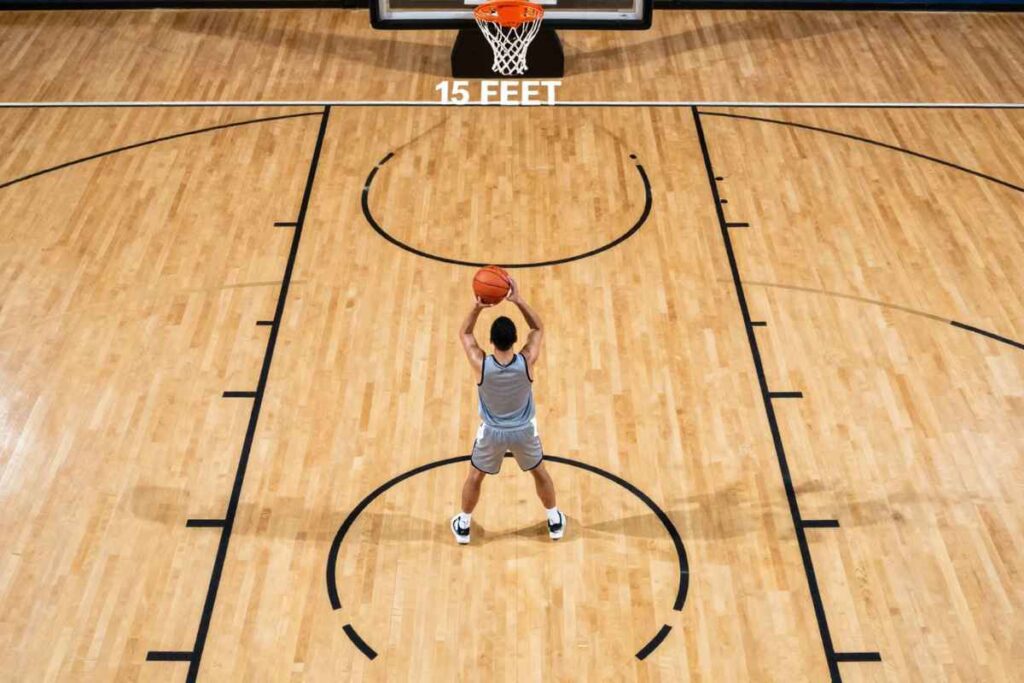
In the NBA, the free throw line is positioned 15 feet (4.57 meters) from the backboard. This distance ensures a consistent challenge for professional athletes while maintaining fair play.
The lane width at this level is 16 feet, creating ample space for positioning and rebounds. Moreover, the three-second rule applies only to offensive players, which regulates time spent in the key unless a shot is taken.
NCAA / College Free Throw Line Distance
College courts follow similar measurements. The free throw line is also 15 feet from the backboard, but the key is narrower at 12 feet.
This slight difference requires players to adjust their positioning and timing for rebounds. In this regard, practice sessions often focus on mastering footwork and spacing within the lane.
High School Free Throw Line Distance
High school courts maintain the standard 15-foot distance, ensuring uniformity with professional levels. However, the lane width is 12 feet and variations can occur depending on local gym specifications.
Coaches often emphasize technique over power at this stage, helping younger athletes develop proper shooting form early on.
FIBA / International Free Throw Line Distance
International competitions, regulated by FIBA, place the free throw line slightly further at approximately 15 feet 1 inch (4.60 meters) from the backboard.
This small adjustment aligns with global court dimensions, which are marginally smaller than NBA courts. Players transitioning between leagues must be aware of these differences to maintain accuracy during international play.
Youth and Developmental Free Throw Distances
Age-Based Adjustments
For young athletes, the free throw line distance is often shortened to accommodate developing strength and coordination.
Typically, ages 7–8 use a 14-foot line, while ages 9–11 may shoot from 14–15 feet. This approach builds confidence and allows players to focus on form rather than purely on distance.
Training Benefits
Adjusting the line helps young players establish proper shooting mechanics, including stance, grip and follow-through.
The aforementioned concept encourages gradual progression to standard distances as skill levels improve. Consequently, this method has been shown to increase free throw success rates and long-term performance.
Basketball Court Dimensions Overview
Full Court Dimensions
A standard NBA or NCAA court measures 94 feet in length and 50 feet in width, while FIBA courts are slightly smaller at 91 feet 10 inches by 49 feet 3 inches.
High school courts can range from 84 to 94 feet long but maintain the same width of 50 feet. Understanding the overall court size helps players contextualize free throw distances relative to other lines and zones.
Key / Free Throw Lane
The lane, also known as the key or paint, is crucial for positioning during free throws and rebounds. Widths vary by league: 16 feet for NBA, 12 feet for NCAA and high school.
The lane extends from the endline to the free throw line, providing both offensive and defensive players space to maneuver. Moreover, the restricted area or no-charge zone, ensures fair play under the hoop.
Free Throw Circle
The free throw circle has a radius of six feet, forming a 12-foot diameter. It defines the shooting area and provides reference points for lane positioning. Coaches often use the circle to teach foot placement and alignment for accurate shots.
Rim Height and Basket Placement
Across all levels, the hoop is set at 10 feet (3.05 meters). Consistent rim height allows players to practice shooting from standardized distances, reinforcing muscle memory and accuracy. In professional play, this fixed height is essential for maintaining skill continuity.
Free Throw Rules and Player Positioning
Shooter Positioning
The shooter must stand behind the free throw line with feet properly aligned. Crossing the line before the ball hits the rim results in a violation. This rule ensures fairness and protects defensive positioning.
Other Players’ Positions
Players line up along the lane in alternating defense-offense order, with a maximum of four on each side. Proper positioning affects rebounding opportunities and free throw outcomes. If a spot is left vacant, the opposing team may occupy it, adding a strategic element to placement.
Violations and Common Mistakes
Common errors include stepping over the line prematurely, lane violations or improper foot alignment. Coaches emphasize discipline during practice to prevent these issues, which can directly influence game performance.
Three-Point Line and Relationship to Free Throw Line
Distance by League
The three-point line differs across levels: NBA corners are 22 feet, arcs 23 feet 9 inches; college courts are 19 feet 9 inches; international courts are 20 feet 6 inches. Understanding these distances helps players gauge court positioning relative to free throw practice.
Shooting Rules
Shooters must have both feet behind the arc when attempting a three-pointer. This rule parallels free throw discipline, reinforcing proper stance and focus, particularly in competitive settings.
Frontcourt and Backcourt Overview
Definition of Frontcourt vs Backcourt
The frontcourt is the half containing the offensive basket, while the backcourt is the defensive half. Recognizing this division is critical for offensive and defensive strategies, especially during fast breaks or set plays.
How it Affects Gameplay
Player movement and positioning relative to these zones influence shot selection, free throw rebounds and defensive coverage. This knowledge helps athletes maximize opportunities during live play.
Historical Background
Origin of the Free Throw Line Distance
The 15-foot standard was established in the early 20th century to balance shooting challenge and fairness. The measurement remains unchanged across most leagues, providing historical consistency.
Changes Across Time
Although some leagues experimented with slight adjustments, the core distance has largely remained stable. This consistency allows players and coaches to develop long-term strategies for free throw training.
Why 15 Feet Was Chosen
Fifteen feet offered the ideal compromise between difficulty and accessibility, making the free throw a skill-based element rather than a test of raw strength.
Measuring the Free Throw Line
How to Measure Distance Correctly
Accurate measurement ensures compliance with league rules. Use a tape measure from the backboard to the nearest edge of the free throw line for precision.
Using Court Lines and Tools
Most gyms mark lines permanently, but portable courts or home setups may require measuring tools. This approach guarantees consistency during practice and games.
DIY/Home Court Adjustments
For home practice, adjust hoop height and line placement proportionally to maintain standard shooting mechanics. This method helps replicate authentic conditions even in smaller spaces.
Tips to Improve Free Throw Shooting
Stance and Form
A balanced stance, proper hand placement and smooth follow-through are essential. Focusing on consistency rather than power yields higher accuracy.
Focus and Mental Techniques
Concentration and visualization help maintain performance under pressure. This particular method reduces distractions during competitive free throws.
Practice Drills by Age/Level
Structured drills, from youth to professional levels, build muscle memory. Examples include repetitive shooting from the line, rebound simulations and timed free throw routines.
Materials and Court Types
Indoor Hardwood Courts
Professional courts are primarily made of hard maple, offering shock absorption and consistent bounce.
Outdoor Concrete or Asphalt Courts
These surfaces affect ball bounce and footing. Players must adjust techniques slightly to maintain accuracy in different environments.
Effects of Surface on Shooting Accuracy
Practicing on multiple surfaces prepares athletes for variable game conditions, increasing adaptability and consistency.
Conclusion
Understanding the free throw line distance is essential for players across all levels. From youth leagues to professional courts, this measurement influences shooting technique, positioning and gameplay strategy.
By knowing the distances, lane dimensions and rules, athletes can practice effectively and perform consistently under pressure.
Combining knowledge with drills, stance and mental focus ensures improved free throw accuracy and overall basketball performance.
FAQ’s
What is the standard free throw line distance in basketball?
The standard distance is 15 feet (4.57 meters) from the backboard for NBA, NCAA, high school and most leagues. FIBA adds a slight adjustment to 15 feet 1 inch.
How far is the high school free throw line from the basket?
High school courts maintain the 15-foot distance, with a key width of 12 feet. Minor gym variations may occur locally.
What is the NBA free throw line distance?
In the NBA, the line is 15 feet from the backboard, with a 16-foot wide lane and a three-second offensive rule.
How do youth leagues adjust free throw distances?
Youth leagues shorten the line for ages 7–11, typically between 14–15 feet, to focus on form and confidence.
How can I measure the free throw line correctly?
Measure from the backboard to the nearest edge of the line using a tape measure or court markings to ensure accuracy.
Does court surface affect free throw shooting?
Yes. Hardwood provides consistent bounce and grip, while asphalt or concrete may require minor technique adjustments.